AI agents without enforced boundaries leak sensitive data in seconds.
PlainID is the only agentic identity platform that secures the entire AI flow, inputs and outputs, data retrieval, and MCP tools.
End-to-end solution
Discover, Manage, Authorize
Enforce all identities
Human and non-human
Scale AI responsibly
With Zero Standing Privileges
Once connected to enterprise systems, AI agents without enforced boundaries can expose sensitive data in seconds or abuse excessive privileges to disrupt critical operations. As these agents reason autonomously and invoke multiple tools, organizations quickly lose control over what the AI can access and do.

Block unauthorized queries based on identity and agent context

Set policies to control which data sources can be accessed
Mask and filter responses to avoid exposing sensitive data
Govern which services and tools agents can invoke
Identify and classify the tools and data sources that require protection
An intuitive Policy Builder suggests actions and components for the agentic guardrails.
No tutorials, no onboarding needed.
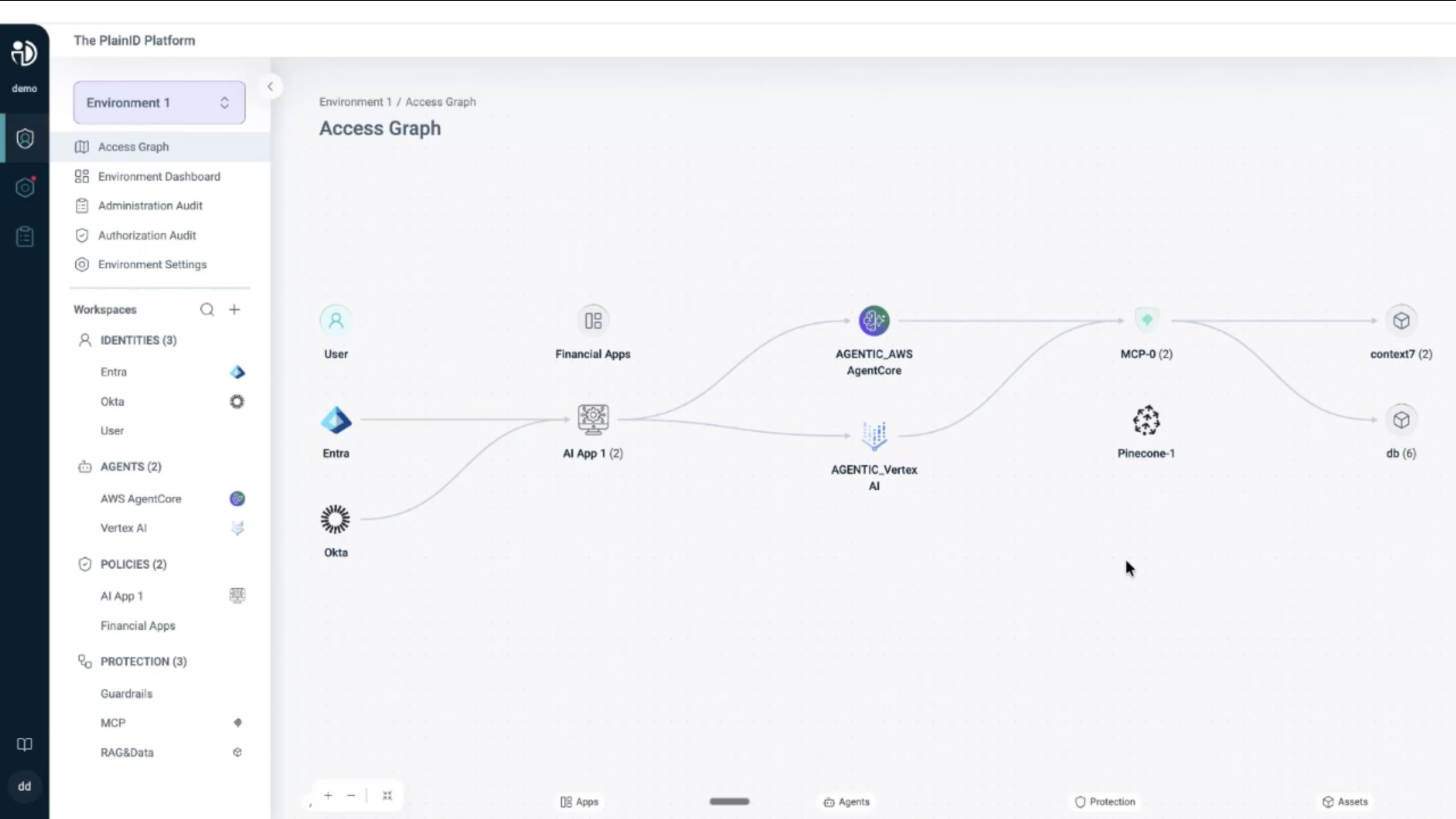
All objects and relationships across the organization are mapped, with clear visibility of where guardrails exist.
Enforce authorization across the AI flow for both human and non-human identities, with flexible integration across major and emerging AI and agent frameworks.

Gartner, How to Secure Custom-Built AI Agents, Dionisio Zumerle, Jeremy D’Hoinne, 11 June 2025 GARTNER is a registered trade mark and service mark of Gartner, Inc. and/ or its affiliates in the U.S. and internationally and is used herein with permission. All rights reserved.
Discover why Fortune 500 enterprises trust PlainID to securely scale agentic AI systems:
Partial, point solutions
True end-to-end control across the AI flow
Prompt → Data → Tools → Output
Fragmented or incomplete
Full lifecycle
Discover → Manage → Authorize
Mostly reactive
Real-time, dynamic authorization
Driven by context and intent
Limited visibility
Every action tied to human & non-human identities
With clear ownership and scope
After-the-fact response
Proactive enforcement before data is retrieved or exposed
With built-in output masking
Raw or technical logs
The only solution with business-readable authorization decisions
Plus full audit trail
PlainID integrates directly into your AI development stack, embedding policy enforcement into the fabric of your agentic AI, without slowing innovation.

PlainID empowers teams to govern AI data and decisions, embedding dynamic policy management and governance at the core of AI pipelines, ensuring responsible, auditable, and scalable AI adoption.

PlainID integrates with frameworks like LangChain to embed centralized, policy based access control (PBAC) directly into AI pipelines. This enforces fine-grained authorization across prompts, data retrieval, tool usage, and response generation, ensuring agents operate within defined security.

PlainID enforces policy-based controls in RAG workflows, ensuring only authorized data is retrieved and used by the right human or non-human identities. This prevents non-compliant data from ever reaching the model.

As AI agents extend beyond simple prompts into full “agentic” workflows, being able to call external tools, databases, and APIs via the Model Context Protocol (MCP), PlainID applies dynamic authorization to govern exactly which tools, APIs, and data agents can be accessed.

PlainID embeds policy enforcement directly into your AI stack, securing agentic AI without slowing innovation.