
AI Agents Need Boundaries. Most Don’t Have Them.

Introducing PlainID’s Agentic Identity Platform
- AI agents operating with broad, standing access are not autonomous. They’re unsupervised. Without enforced boundaries, sensitive data can be exposed in seconds.
- Static permissions and standing privileges cannot keep pace with agentic AI operating at machine speed. Zero Standing Privileges (ZSP), just-in-time, purpose-scoped, and automatically revoked, is the only model that scales.
- Gartner, CSA, and OWASP all identify runtime access control as the critical missing layer in AI security. 4 out of 10 OWASP top risks for agentic AI are access control failures.
- PlainID enforces four dynamic guardrails across the full AI flow: Input, Data Retrieval, MCP Tools, and Output, binding every decision to human and agent identity, intent, and context.
- This goes beyond access controls: pre-retrieval filtering, parameter governance, enrichment without data movement, and built-in output masking.
- One unified platform, Discover, Manage, Authorize, so you don’t need multiple point solutions to secure your agentic AI stack.
Consider this situation in your organization:
As part of an enterprise agentic AI system, your company deploys an AI agent to help customer support teams resolve complex cases faster. The agent is integrated with core systems such as Salesforce, Zendesk, Snowflake, and internal billing platforms, and is granted broad access so it can operate efficiently.
Now a specific case shifts from a routine inquiry to a billing dispute. To resolve it, the agent pulls additional context and, using the same standing permissions it was given for general support tasks, accesses detailed billing records that include customer PII, surfacing them in a workflow where they don’t belong.
But what if the agent was granted permissions just in time, scoped only to the specific task at hand, for a narrow window, and automatically revoked once that intent was fulfilled?
In that model, the agent could still resolve the case, but it would never carry forward access that no longer applied.That’s Zero Standing Privileges in practice.
The Problem Organizations Face: Agents Without Boundaries Expose Sensitive Data in Seconds And Traditional Controls Can’t Keep Up
We see this in many organizations: AI agents are deployed to automate business processes, but without predefined boundaries, they go off track fast.
Once connected to your systems, an agent without clear boundaries can:
- Access and expose sensitive data in seconds
- Use its excess privileges to disrupt critical operations
- Operate with insufficient evidence and minimal auditability
Leading security frameworks and analysts recognize that traditional access controls are insufficient for the dynamic nature of agentic AI:
- Gartner identifies “runtime boundaries” as a critical gap in AI governance and predicts that through 2029, over 50% of successful cybersecurity attacks against AI agents will exploit access control weaknesses.
- The Cloud Security Alliance (CSA) calls for a new AI IAM framework, positioning dynamic authorization as a core architectural layer for agentic systems.
- OWASP’s Top 10 for Agentic Applications 2026 identifies 4 out of 10 top risksas access control failures.
Zero Standing Privileges Is the Only Model That Scales for Agentic AI
Agentic AI doesn’t pause between actions. It plans, reasons, and executes across systems at machine speed. Zero Standing Privileges (ZSP) means no identity, human or machine, has ongoing, permanent access by default. Instead, permissions must be:
- Granted just-in-time
- Scoped to a specific purpose
- Revoked immediately after use
For human users, zero standing privileges reduces blast radius. For agentic AI, it is essential.
Intent-based access control means access decisions are driven by the specific purpose of the request, not by static, standing permissions.
- Intent defines why access is needed
- ZSP ensures access exists only for that reason, and only for that moment
Today, we’re introducing a pre-release of PlainID’s Agentic Identity Platform,built to help organizations restore order to the chaos caused by boundaryless agents, enforcing real runtime boundaries across the full AI flow.
A Purpose-Built Platform that Enforces at Runtime, Not a Generic Governance Tool
Authorization at runtime: centralized control over what AI agents can access, do, and expose across the full AI flow through dynamic, policy-based guardrails.
PlainID addresses the critical missing layer: runtime boundaries. We enforce control at the moment of execution, governing what AI agents can access in real time, across your entire technology stack.
This is the only end-to-end, enterprise-grade authorization platform designed to control agentic AI access at scale. Built on PlainID’s proven PBAC foundation, it extends dynamic authorization into AI-native enforcement and user experience.
With control over all identity types, and guardrails across the full AI flow, it gives organizations control over autonomous agents, ensuring they act only within authorized boundaries and that they don’t expose sensitive data. PlainID achieves this by combining the agent’s context (e.g., agent type or tool usage) with the human user’s context (e.g., identity, location, or entitlements) to enforce granular access across the flow.
Not Point Solutions. Full Coverage Across Every Layer of the Agentic Flow.
At PlainID, we identified four critical control points that must be governed with dynamic guardrails to secure agentic AI. Unlike fragmented point solutions that address isolated checkpoints, PlainID enforces full coverage across the entire flow:
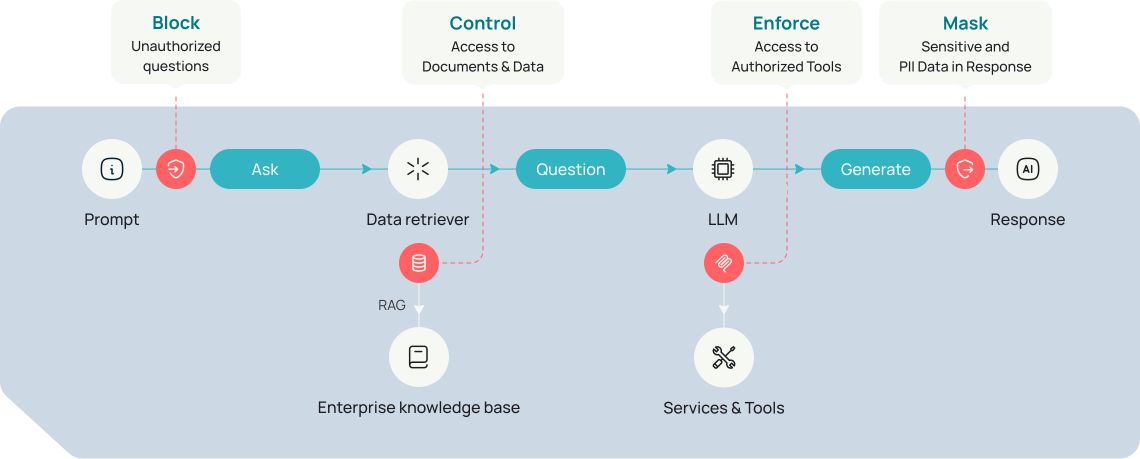
Input Guardrail
Interprets user intent, reads identity signals, evaluates policy permissions, and approves or blocks prompts in real time.
- Bind Intent to Identity
- Check Policies Before Retrieval
- Enforce Approved Scope
Data Retrieval Guardrail
Applies filters to structured and unstructured data retrieval based on authorized topics and user context.
- Structured & Unstructured Data
- Govern Topics & Metadata Access
- Prevent Unauthorized Retrieval at the source.
MCP Guardrail
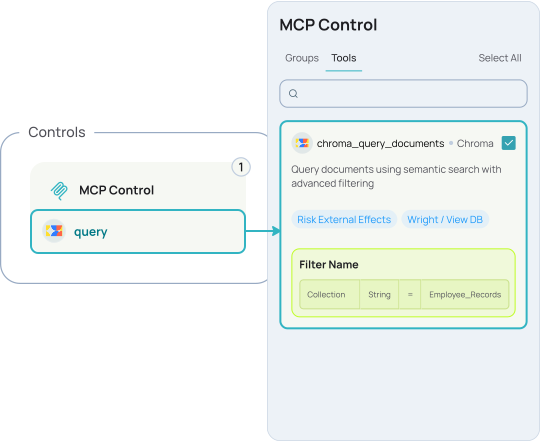
Identifies available tools, validates identity and context, and enforces what actions agents are allowed to perform.
- Discover & Classify Tools
- Validate Identity & Context
- Constrain Actions to Scope
Output Guardrail
Prevents unauthorized data exposure before responses are delivered.
- Stop Unauthorized Disclosure with Prebuilt Response Masking Capability
- Validate Responses Against Policy
- Bind Output to Identity & Explainability
Not Just Access Controls. Dynamic Runtime Enforcement with Enrichment, Filters, and Context.
PlainID goes far beyond traditional yes/no access decisions. We enforce:
- Granular data-level filters and constraints: Applied before data is retrieved or exposed
- Enrichment without movement: Add classification tags and metadata
- Dynamic constraints: Adjust access based on real-time context
- Built-in output masking: Dynamically redact sensitive information
Not Fragmented Tools. One Platform to Discover, Manage, and Authorize.
PlainID delivers the full breadth of agentic AI access authorization in one unified platform—from discovery and classification, to policy management, to real-time enforcement.
Discover: Gain insight into the data and tools to be protected. Connect to vector databases (e.g., Pinecone) to inventory and enrich classifications. Automatically discover the MCP tools that your organization intends to use and classify them according to categories of usage.
Manage: Describe intent in natural language and build policies through our no-code Policy Builder, which interprets intent and assembles the right policy components. Gain graph-based visibility into any object in the agentic flow and all its related identities, datasets, and tools. Access decision logs with reasoning data for audits and regulators.
Authorize: Enforce policies across Input, Data Retrieval, MCP Tools, and Output guardrails. Human, NHI, and Agent Identity are all considered in the enforcement flow. Works across all major and emerging AI development and agent frameworks, with its enforcement module fully compatible with the enterprise technology stack.
Not Another AI Assistant. Daia Secures Your Organization’s Agentic AI.
Meet Daia (pronounced Da-yah, rhymes with “data”): securing your agentic AI, guiding policy creation, governance, and enforcement across the full AI flow.

Daia is so much more than a productivity copilot. It does the heavy lifting of policy management; it is the intelligence layer connecting identity, intent, and policy across the full agentic AI flow. It translates natural language intent into enforceable policies, recommends guardrails, and provides intelligent guidance as you build authorization controls that scale.
Why PlainID
Fortune 500 enterprises trust PlainID to secure access for millions of identities at global scale.
Scaling agentic AI may seem like it requires a new rule set. But in fact, our enterprise customers seamlessly transfer the same dynamic authorization principles used across their data, applications, and APIs to their newly deployed AI systems.
As agents operate continuously across regions, datasets, teams and systems, Zero Standing Privileges is the only model that enforces dynamic boundaries at scale while keeping sensitive enterprise data protected, auditable, and compliant.
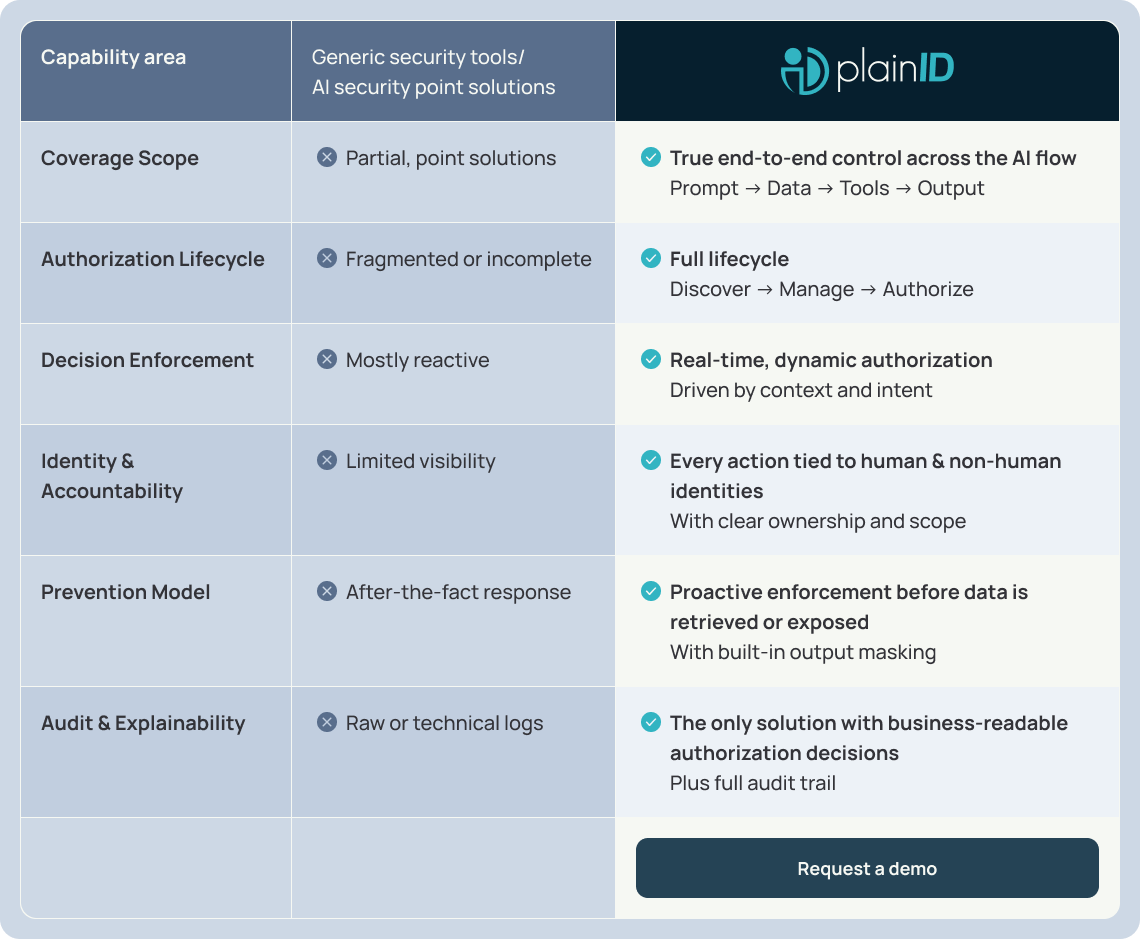
PlainID’s solution is technology-agnostic across the policy lifecycle, integrating with all major AI frameworks and agent platforms, while its Authorization enforcement module fully adjusts to the organization’s specific technical stack.
What This Enables: Scale AI Responsibly
PlainID enables enterprises to reduce risk, prevent sensitive data exposure, ensure explainability, and meet compliance obligations in AI-driven environments, at scale.
Build AI with Identity-First Security: Ensure every AI action is bound to the user’s identity and entitlements.
Minimize Risk with Dynamic, Context-Aware Enforcement: Reduce data exposure, misuse, and unauthorized actions through real-time controls.
Centralize Control once, Enforce across your organization: Manage access decisions at every stage: prompt, data retrieval, generation, and response.
Enable Auditing and Observability: Ensure alignment with regulatory requirements by maintaining consistent, auditable access decisions in a plain business language.
Related articles
Zero Standing Privileges for Agentic AI
Unlike traditional applications that follow deterministic workflows, agentic AI systems reason about objectives, dynamically…
Static Authorization Is Not Enough for AI Agents
In a recent conversation with a security team rolling out agentic AI workflows for…
Secured by Design: Building Trustworthy Agentic AI from the Ground Up
The Shift: From Reactive Security to Security by Design By Gal Helemski For…