

LangGraph
Apply policy controls to LangGraph agent workflows, actions, prompt, output, data retrieval, and tool use.

About PlainID + LangGraph
LangGraph is an open-source framework built on top of LangChain that enables developers to construct LLM applications by using graph-based architectures to model and manage the intricate relationships between various components of an AI agent workflow.
The PlainID Authorizer for LangGraph is an identity-aware authorization layer that brings centralized Policy-Based Access Control (PBAC) to graph-based AI pipelines. It applies fine-grained access enforcement across every node in the graph, guaranteeing that agent behavior remains fully aligned with enterprise security policies at all times.
Authorization is applied across the entire graph, covering prompt handling, data retrieval, and response generation. These control points provide granular control at every stage of graph execution and act as distributed guardrails, minimizing risks such as unauthorized data access, privilege escalation, or unintended agent behavior.
Technical Information
The PlainID LangGraph Authorizer is implemented as a Python library that integrates natively into LangGraph agent graphs, keeping user identity and access entitlements active and enforceable throughout every node execution and graph state transition, preventing AI agents from operating beyond their authorized scope.
Architectures
1. Prompt Submission & Category Authorization
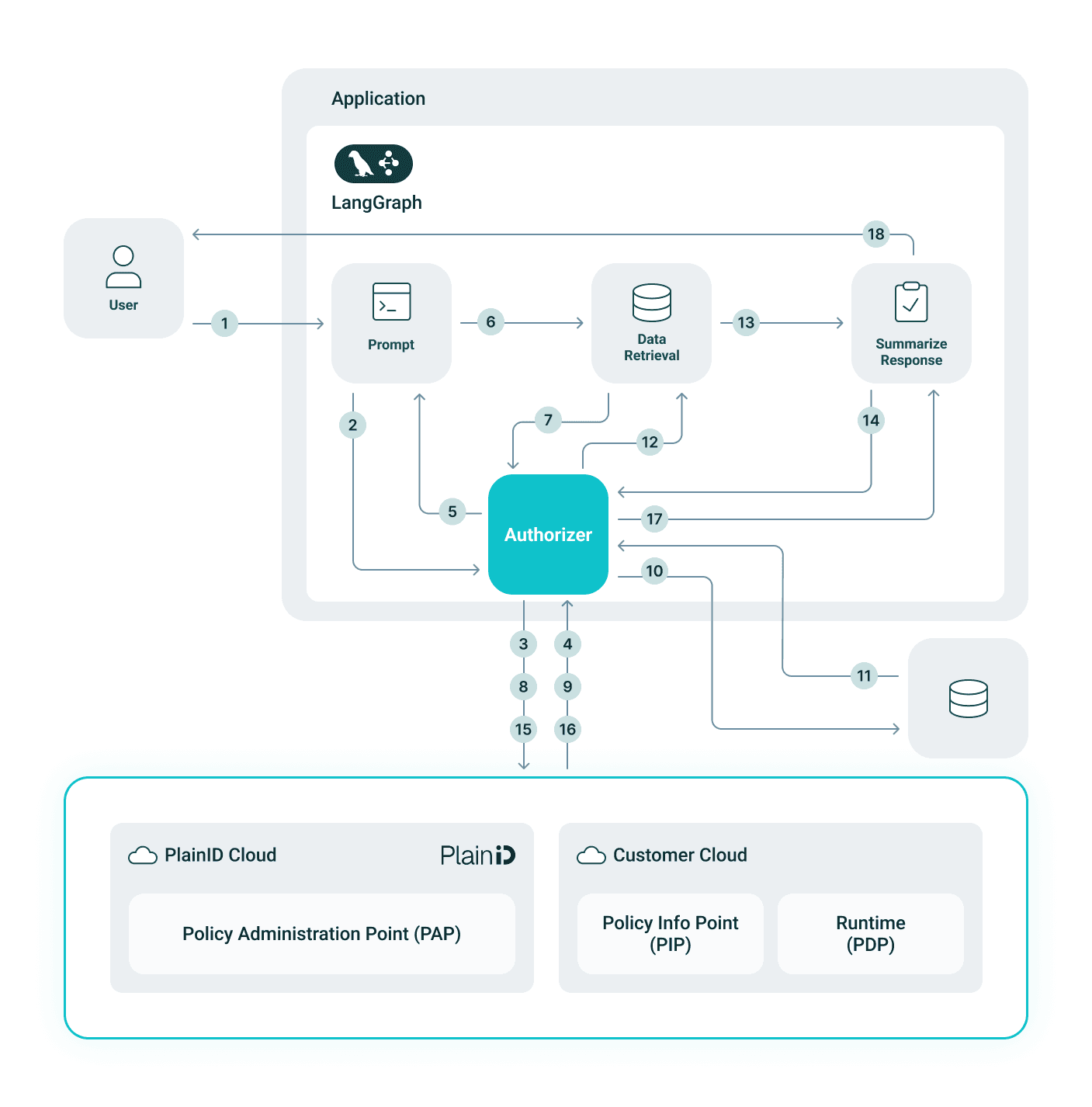
A user submits a prompt through a LangGraph application (1).
The Prompt node delegates the request to the Authorizer (2). The Authorizer uses an LLM to categorize the request and queries PlainID to verify whether the user is allowed to access the identified category (3,4).
The resulting policy decision is propagated back to the Prompt node (5), and graph execution only continues if the request falls within the user's authorized scope.
2. Data Access Control & Retrieval
Once the prompt is authorized, the graph routes execution to the Data Retrieval node (6). The Data Retrieval node calls the Authorizer (7) to apply document-level enforcement via PlainID policies (8, 9).
The Authorizer filters the query based on metadata entitlements and fetches only the permitted documents from the vector store (10, 11), returning the filtered results back to the Data Retrieval node (12).
3. Summarization of Authorized Content
The permitted documents are carried through the shared graph state into the Summarize Response node (13).
LangGraph processes only the data the user is entitled to access, generating a contextually relevant response to the user's query.
4. Anonymization & Secure Response Delivery
Prior to returning the final output, the Summarize Response node engages the Authorizer (17) to apply anonymization (if needed). The Authorizer checks with PlainID (15, 16) to detect sensitive data such as PII and applies masking or redaction based on policy (14). The final, policy-compliant response is delivered to the user (18).
Technology
- Agentic frameworks
Capabilities
- Manage
- Enforce
Auth Patterns
- Agentic Authorizations (Guardrails)
- RAG Authorizations
Need help integrating?
Our experts can help you architect the perfect authorization strategy for your stack.

Better Together
Connect Context. Centralize Policy. Enforce Everywhere.