


LangChain
Apply policy controls to LangChain agent actions, prompt, output, data retrieval, and tool use.

About PlainID + LangChain
LangChain is an open-source framework that enables developers to build LLM-powered applications, offering modular components such as chains, agents, memory, tools, and integrations for easily connecting language models to external data sources, APIs, and services.
The PlainID Authorizer for LangChain is an identity-aware access control solution that secures agentic AI workflows with centralized Policy-Based Access Control (PBAC) by enforcing fine-grained authorization, ensuring AI agents comply with security access policies.
Each stage of the LangChain flow: prompt input, data retrieval, and responses generation is independently secured, acting as modular guardrails. This modularity provides dedicated control points at each stage, reducing the risk of privilege escalation or data exposure.
Technical Information
The PlainID LangChain Authorizer is a Python library that integrates directly into LangChain-based agents, preventing AI overreach by ensuring user context is maintained across every agent action.
Architectures
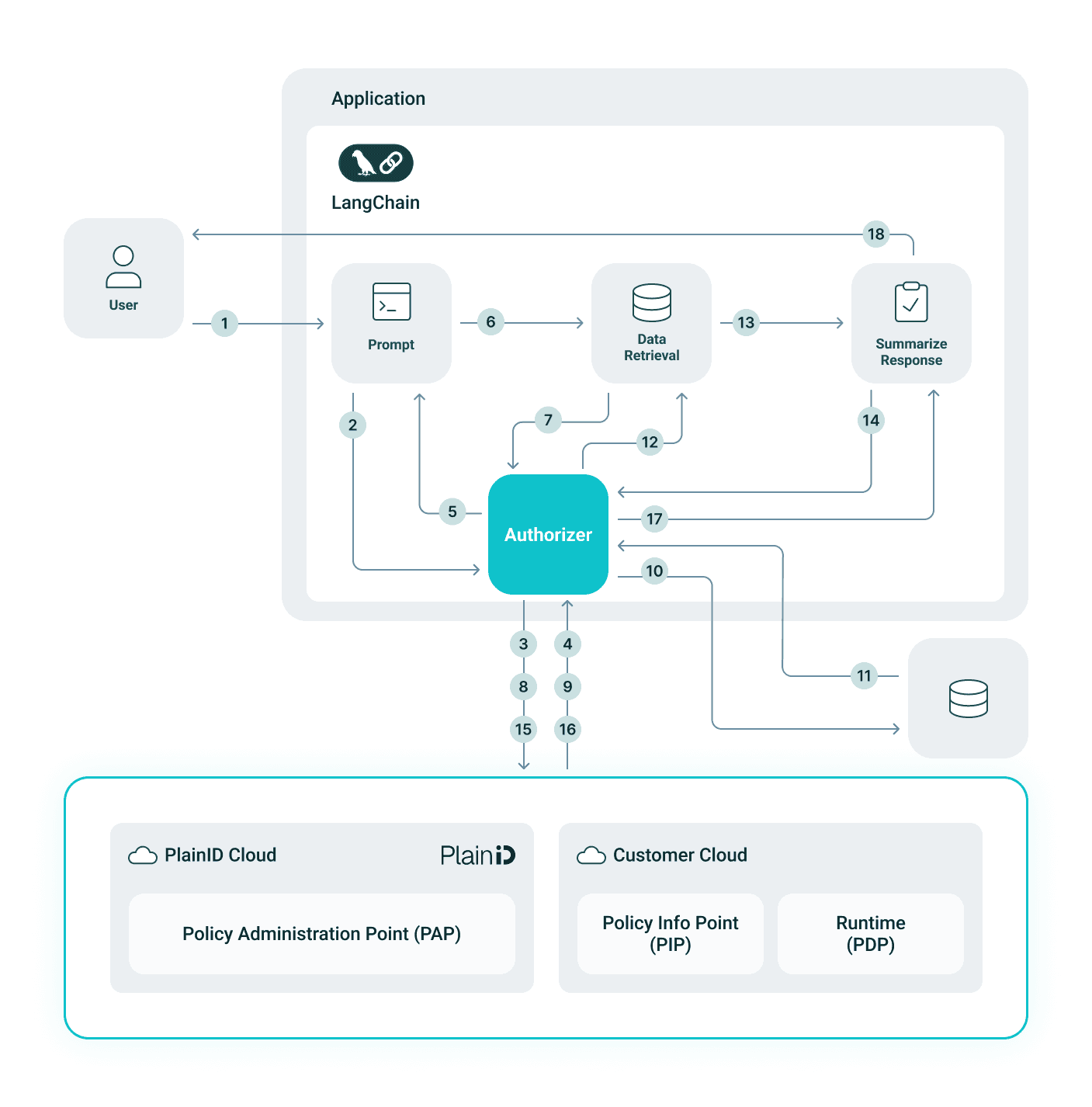
1. Prompt Submission & Category Authorization
The user submits a prompt via the LangChain-based application(1).
The Authorizer uses an LLM to classify the prompt into categories and queries PlainID to determine which categories the user is authorized to access(3).The application proceeds only if the prompt is permitted.
2. Data Access Control & Retrieval
To answer the prompt, the application triggers data retrieval.
It asks the Authorizer(7) to enforce document-level access using PlainID policies.
The Authorizer filters the query based on metadata entitlements and retrieves only the allowed documents from the vector store(10).
3. Summarization of Authorized Content
The filtered documents are returned to the application.
LangChain summarizes the authorized data to generate a relevant response to the user's query(13).
4. Anonymization & Secure Response Delivery
Before delivering the answer, the application requests anonymization based on user-specific privacy rules.
The Authorizer consults PlainID(15) to identify sensitive content (e.g., PII) and applies masking or redaction as needed.
The final, secure response is returned to the user(18).
Technology
- Agentic frameworks
Capabilities
- Manage
- Enforce
Auth Patterns
- Agentic Authorizations (Guardrails)
- RAG Authorizations
Need help integrating?
Our experts can help you architect the perfect authorization strategy for your stack.

Better Together
Connect Context. Centralize Policy. Enforce Everywhere.