Ping establishes who your AI agents are. PlainID controls what they can access, do, and expose at the moment of every action.
What will you do when:
The agent’s delegated scope is valid,
but it retrieves 10x more sensitive data than the task requires?
Individual tool calls are permitted,
but their sequence leads to an unauthorized data exfiltration event?
Sub-agents spawn dynamically at runtime
and operate completely outside your registered identity model?
Ping Identity’s Identity for AI suite does what IAM should do for the agent era: it registers agents as trusted identities, scopes their delegated authority, and enforces least privilege at the tool layer. That is necessary infrastructure.
But a confirmed identity is not an authorization decision. The moment an agent acts, retrieving data, invoking a tool, returning a response, a different question applies: should this specific action, on this specific data, in this specific context, right now, be permitted?
Where Ping establishes the identity boundary, PlainID enforces what happens within it.

Ping’s Agent Gateway and PingAuthorize secure the tool and API boundary. But PlainID enforces authorization everywhere decisions actually happen: blocking unauthorized intent before execution, filtering what data can be accessed, governing which tools agents can invoke, and masking what is exposed. We govern the full agentic flow: prompt, data, tools, and output.

PingAuthorize provides ABAC at the structured API layer, but it is blind to the LLM’s context window. PlainID enforces fine-grained access controls directly at the unstructured data platform layer. Pre-retrieval RAG filtering ensures the agent never retrieves what it shouldn’t, while built-in dynamic output masking intercepts and redacts sensitive data in the AI-generated response before it reaches the user.
Ping implements delegated authority, linking an agent token to a human user at registration. But a delegation record is not the same as runtime binding. PlainID ties the initiating human’s real-time entitlements, role, and clearance into every authorization decision the agent makes downstream. An agent cannot access what its initiating human cannot access, evaluated at the moment of every call.
Least privilege at the delegation scope level still relies on standing permissions. PlainID enforces true Zero Standing Privileges (ZSP). Access is granted dynamically, just-in-time, per action, based on current context, purpose, and policy, and revoked immediately after use.
Discover why Fortune 500 enterprises trust PlainID to securely scale agentic AI systems:
Agent Gateway secures MCP (vertical tool calls) and structured APIs
True end-to-end control across the AI flow: Prompt → Data → Tools → Output
API-only data filtering; blind to unstructured AI data and RAG pipelines
Row, column, and field-level enforcement including RAG pipelines and vector databases
Can mask structured API response fields; blind to synthesized LLM output
Dynamically intercepts and masks sensitive data in LLM-generated outputs before delivery
Gateway enforcement at the tool layer checking predefined OAuth scopes
Real-time, dynamic authorization driven by context and intent at every action
Delegation record: agent token scoped to initiating human identity
Runtime binding: every agent action constrained by the initiating human’s real-time clearance
Least privilege via static OAuth scopes set at delegation time
Proactive enforcement with Zero Standing Privileges (ZSP) minted per action
Enforces on registered agents; dynamically spawned agents may not be in scope
Enforces on all agents including those spawned dynamically at runtime
Requires two separate products: Agent Gateway + PingAuthorize, each purchased and integrated independently
Unified, out-of-the-box enforcement across APIs, data, and AI agent frameworks
Runtime identity layer: establishes who agents are and their delegated authority
Runtime authorization layer: enforces what they can access, retrieve and expose at every action
Ping Identity verifies identity. PlainID controls what AI agents can actually do across the entire agentic AI flow.
Ping Identity’s for AI suite registers agents as trusted identities, scopes their delegated authority, and enforces least privilege at the tool layer. But authenticating identity alone is no longer enough. PlainID enforces authorization everywhere decisions actually happen: blocking unauthorized intent before execution, filtering what data can actually be accessed, governing which tools agents can invoke, and masking what is exposed.
Enterprises running Ping for identity do not have to wait to govern what their agents access, retrieve, and expose. PlainID works alongside Ping Identity, filling the critical runtime and data-layer gaps immediately.
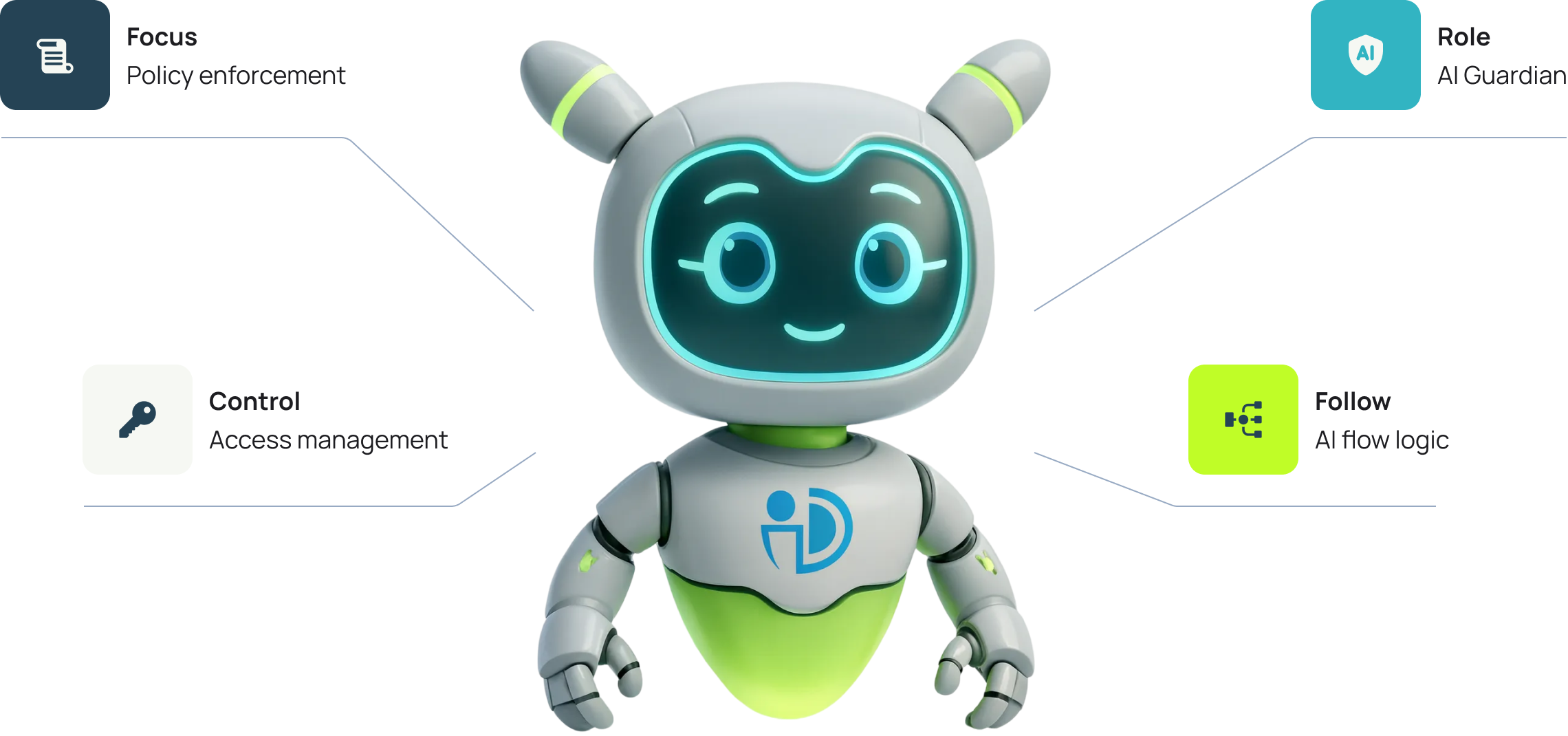
PlainID’s Runtime Authorization Platform is designed for how AI systems actually operate by accessing data, invoking tools, and making decisions across systems in real time. It provides centralized management with distributed enforcement across your entire enterprise stack.
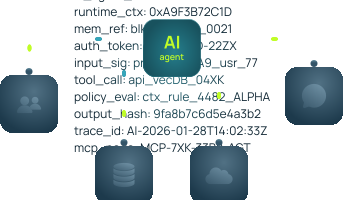
This is the critical control layer missing from traditional IAM. Every decision evaluates:
Access exists only when it’s needed, and only for the exact purpose it’s required. It’s later revoked immediately after use.
Gartner, How to Secure Custom-Built AI Agents, Dionisio Zumerle, Jeremy D’Hoinne, 11 June 2025 GARTNER is a registered trade mark and service mark of Gartner, Inc. and/ or its affiliates in the U.S. and internationally and is used herein with permission. All rights reserved.
Privilege management determines who can access your environment. Runtime authorization governs what happens inside it, at agent speed, at enterprise scale, at the moment of every action.
See how it works in your environment.

Privilege management determines who can access your environment. Runtime authorization governs what happens inside it, at agent speed, at enterprise scale, at the moment of every action.