


PlainID Runtime
Authorization Platform
Centralize Authorization. Enforce It Everywhere.
One platform to discover, manage, and enforce authorization for every identity - human, non-human, and AI agent - across applications, APIs, microservices, data, and agentic AI.
Centralized policy management gives organizations consistency, visibility, and governance. Distributed decisioning and pre-built Authorizers enforce fine-grained access close to the resource, with the performance, resilience, and flexibility required for enterprise environments.
PlainID architecture
Control What Every Identity Can Access,
Do, and Expose.
PlainID Authorization Platform: Logical Architecture
Centralized management. Distributed runtime authorization. Consistent enforcement everywhere.
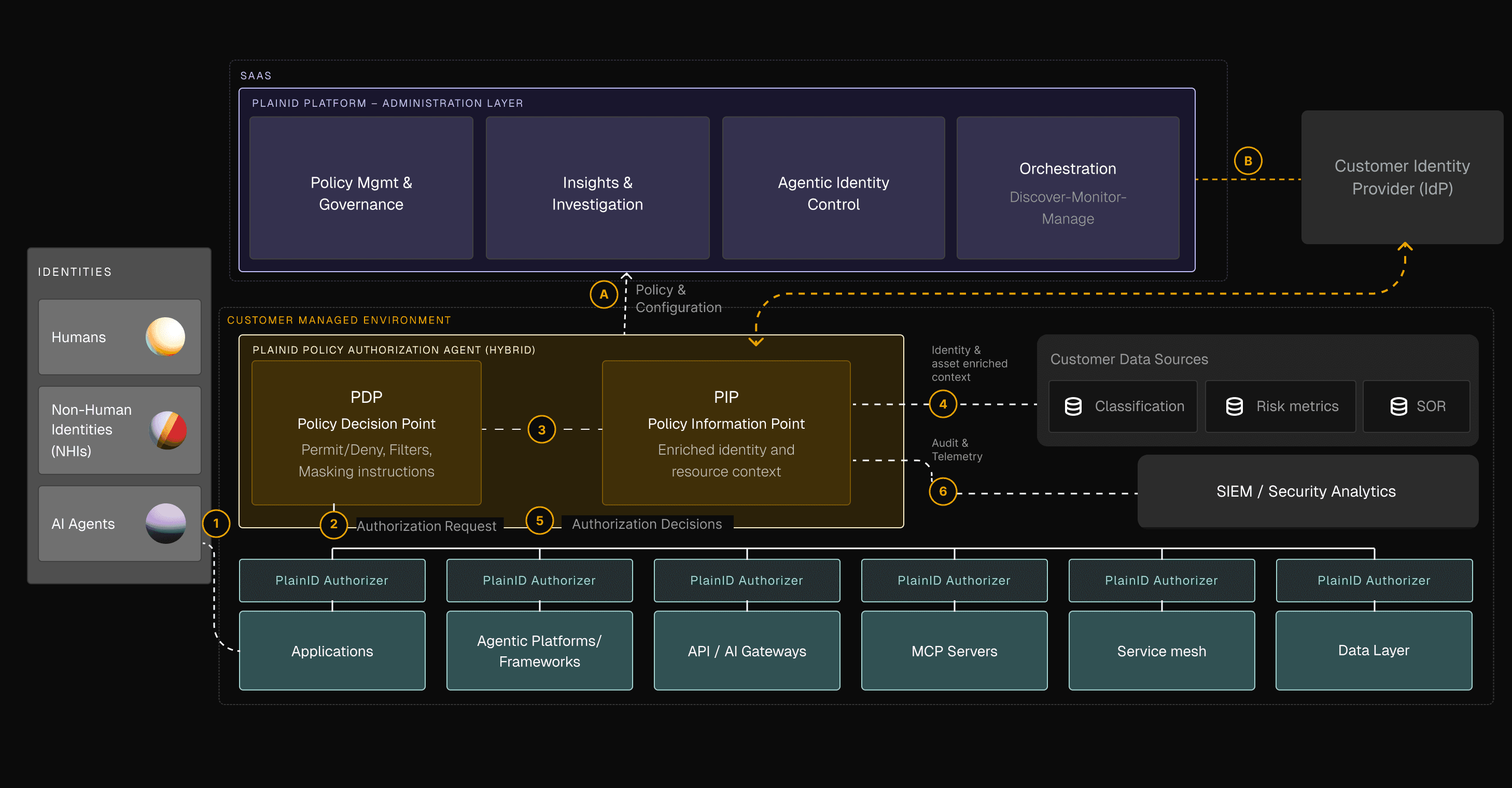
The Authorization Control Plane for the Enterprise
One policy fabric for every identity, resource, and access path.
Define and govern policy centrally, instead of maintaining authorization logic independently within every application, API, data platform, or AI workflow.
PlainID distributes decisioning and enforcement to the points where access occurs. The result is a consistent authorization model that can evaluate:

Who or whatis acting

On whosebehalf

What actionis being requested

Which resourceor data is involved

Whatbusiness and security context applies

Whythe access is needed

What informationmay be exposed
Core platform pillars
One Platform for the Complete
Authorization Lifecycle
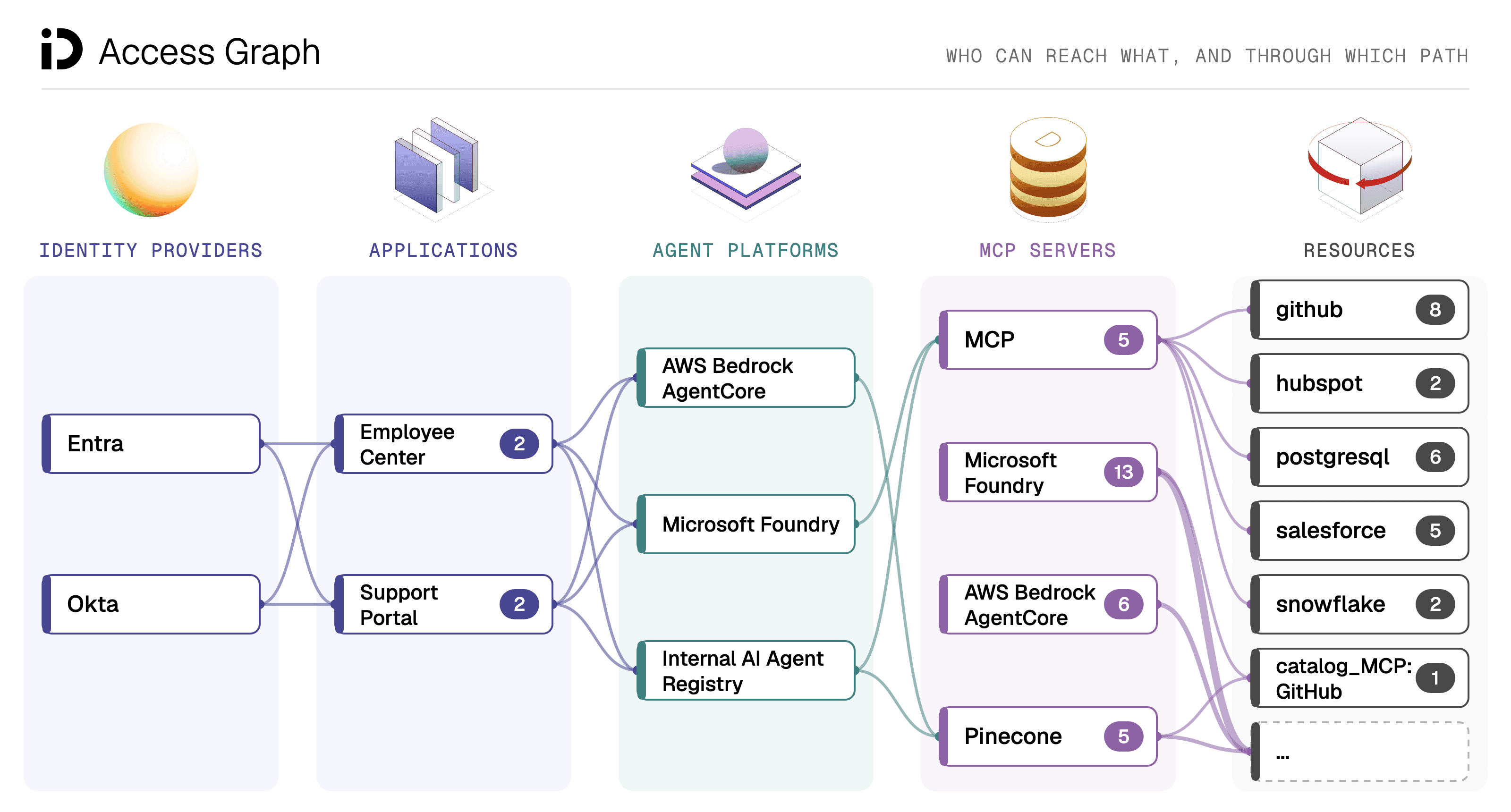
Understand what exists and how it is accessed
Discover and enrich identities, AI agents, resources, MCP servers, tools, APIs, data sources, policies, and access relationships. Establish the visibility and context required to govern access effectively.
Capabilities include:
- Agent, tool, MCP, and resource discovery
- Identity and resource enrichment
- Existing policy discovery
- Access relationship mapping
- Ownership, purpose, sensitivity, and risk context
- Visibility into direct and indirect access paths
Create and govern authorization policy centrally
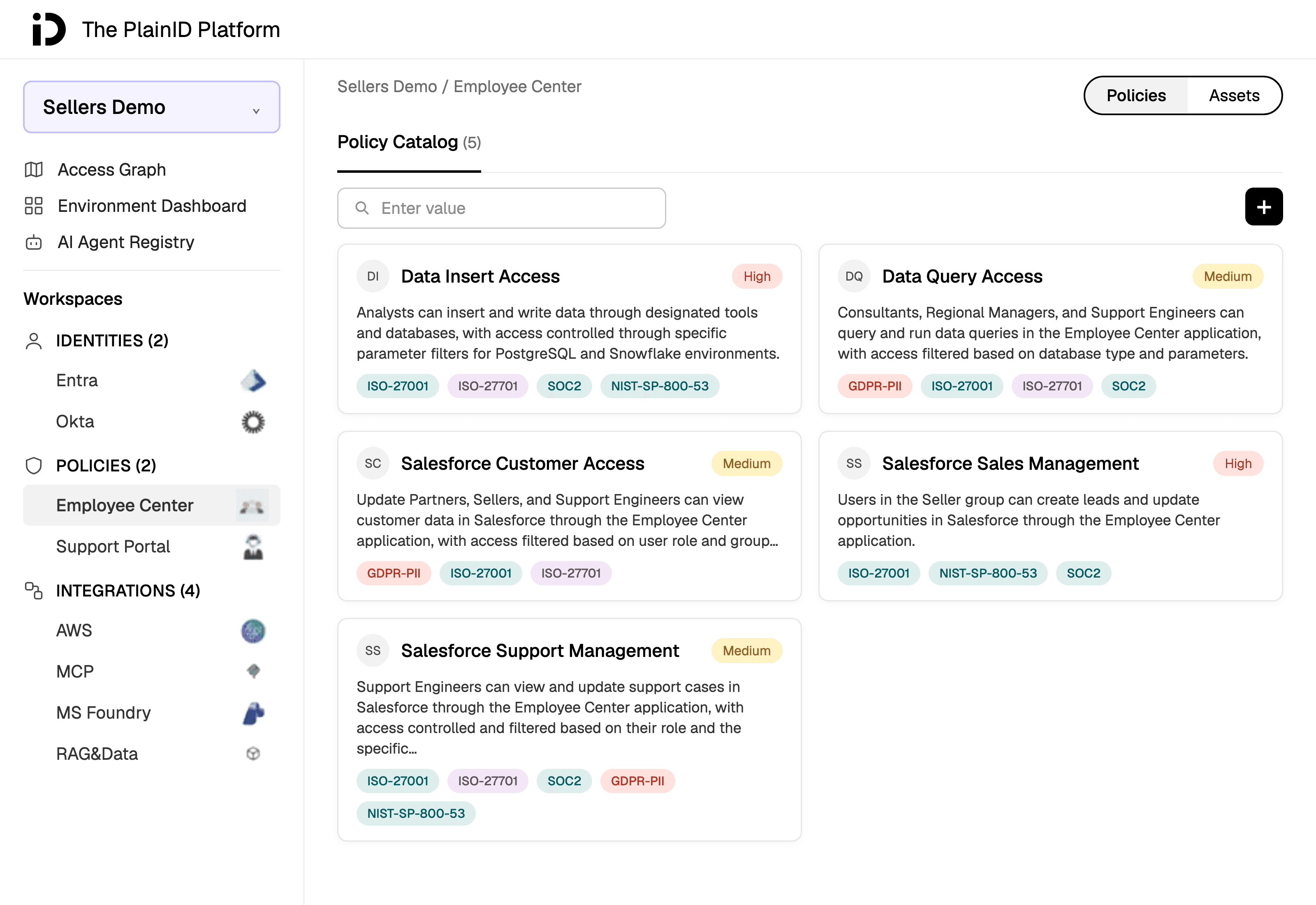
Define authorization policies once and manage them through a controlled lifecycle. Give business and security teams understandable policy models while enabling developers to work through as they are used to.
Capabilities include:
- Business-friendly policy authoring
- Policy as Code and structured Rego
- Policy360 visualization
- Policy lifecycle management
- Testing, simulation, and impact analysis
- Versioning, approvals, and controlled promotion
- Delegated administration and Separation of Duties
- Certification, audit, and explainability
- Native policy management and orchestration
Apply policy at the moment of access
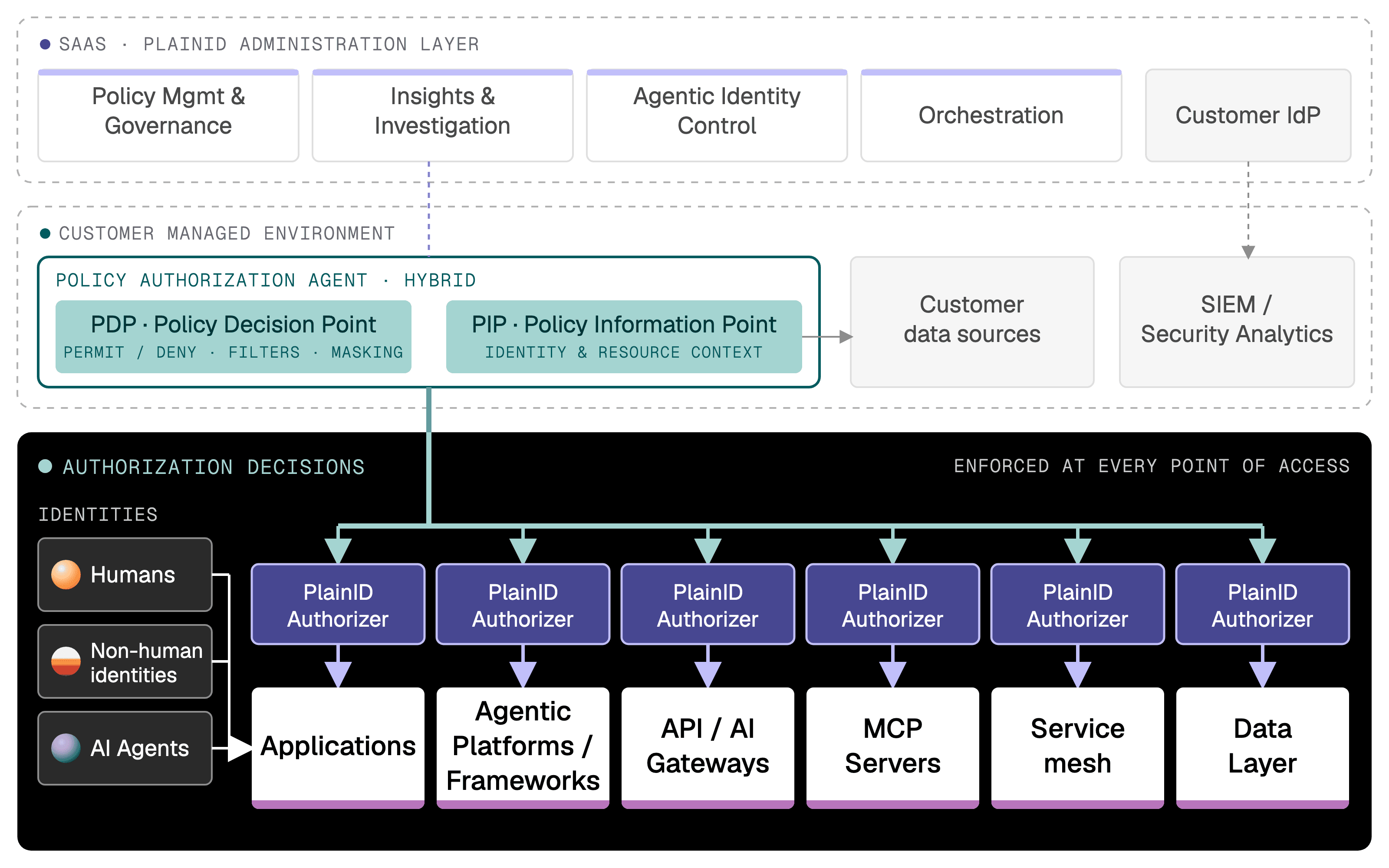
Evaluate authorization dynamically using identity, resource, action, business, environmental, and risk context. Enforce decisions across the enterprise through distributed PlainID Authorizers and native platform controls.
Outcomes can include:
- Permit or deny
- Allowed operations or entitlements
- Row and document filters
- Column and response masking
- Claims and scopes
- Permitted tools
- Parameter constraints
- Approval or step-up obligations
Platform components
Purpose-Built Components
for Enterprise Authorization
- 01

Administration Layer
Policy Administration Point (PAP)
Central policy management and governance
A single place to author, organize, test, approve, certify, explain, and audit authorization policies across identities, resources, and enforcement patterns.
It enables business, security, and engineering teams to collaborate through synchronized visual, declarative, and Policy as Code experiences.
Policy Orchestration
Central governance for native authorization
Some platforms should continue to enforce authorization through their own native policy engines. PlainID discovers, visualizes, governs, translates, distributes, and monitors those policies from a central management layer.
This allows organizations to combine externalized runtime authorization and native enforcement under a consistent governance model.
- 02

Decisioning Layer
Policy Information Point (PIP)
Context enrichment from authoritative sources
Retrieves identity, resource, business, environmental, and risk information required for a decision.
Our PIPs allow policies to use context from identity providers, directories, systems of record, data-classification platforms, asset inventories, security systems, and other enterprise sources—without embedding those integrations in every application.
Policy Decision Point (PDP)
High-performance runtime decisioning
Evaluate authorization policy at the moment access is requested and combine transaction context with centrally governed policy to calculate the precise access permitted for each interaction.
Our PDPs can be distributed close to workloads to support low-latency, resilient, high-volume authorization.
- 03

Enforcement Layer
Authorization audit and insights
Explainable authorization activity
PlainID records the identity, resource, action, evaluated context, applicable policy, and decision outcome. This provides an audit-ready view of who or what accessed which resource, when, why, and under which policy.
Authorization telemetry can also be shared with enterprise SIEM and security analytics systems.
PlainID Authorizers
Pre-built enforcement across the technology stack
PlainID Authorizers connect the platform to applications, API gateways, microservices, identity platforms, data systems, AI frameworks, and MCP infrastructure.
They translate technology-specific requests into authorization decisions and apply the resulting permit, deny, filter, mask, claim, obligation, or parameter constraint.
Why PlainID
A Complete Enterprise Authorization Platform

Every identity in one authorization model
Govern humans, NHIs, and AI agents - including composite user-agent and agent-to-agent transactions - without creating separate authorization silos.

Centralized management with distributed enforcement
Standardize policy and governance centrally while making and enforcing decisions close to applications, APIs, data, services, and AI workloads.

Runtime authorization at enterprise scale
Replace broad standing permissions with dynamic, fine-grained decisions designed for mission-critical performance, resilience, and transaction volumes.

Pre-built Authorizers
Accelerate deployment through enforcement integrations for applications, identity platforms, API gateways, microservices, data platforms, AI frameworks, and MCP infrastructure.

Control from API to data
Go beyond application-level allow or deny to control operations, parameters, rows, columns, documents, response fields, and agent outputs.

Business-friendly and developer-ready
Enable policy owners to understand and govern authorization while giving engineers APIs, Policy as Code, Git, and CI/CD integration.

Externalize or orchestrate
Use dynamic PlainID decisions where appropriate and centrally govern native authorization where local enforcement is preferred.
Business value
Turn Authorization Into an Operational Security Control

Reduce standing privilege
Calculate access at runtime and limit it to the minimum required for the specific action.

Create consistent enterprise policy
Replace fragmented rules and hardcoded access logic with centrally governed authorization.

Accelerate change
Update business access rules without requiring separate development work across every connected application.

Improve auditability
Provide an explainable record of who or what accessed each resource, what policy applied, and why the decision was made.

Protect sensitive data
Apply fine-grained controls directly to the records, fields, documents, and outputs that identities can retrieve or expose.

Scale responsible AI adoption
Give AI agents defined, enforceable boundaries without requiring every AI development team to build its own security model.

Bring Every Access Decision
Under Control
Centralize authorization policy, distribute enforcement across your enterprise, and control what every human, non-human identity, and AI agent can access, do, and expose.