Idira governs who has access. PlainID controls what AI agents can do with it.
What will you do when:
Your AI agent has scoped privileges
but retrieves 10x more data than the task requires
An agent’s access was provisioned correctly
but no one enforced what it did at runtime
You know which agents exist
but you cannot explain every action they took and why it was allowed
Idira discovers identities, scopes privileges, and governs the access lifecycle. That is important work. But it is not the same as runtime authorization.
Privilege management determines what an identity is allowed to access before a session begins. Runtime authorization determines whether a specific action is permitted at the exact moment it is attempted — with live context, applied to every step of an agent’s workflow.
When an AI agent is mid-task, Idira has already done its job. PlainID is the layer that governs what the agent can access, do and expose.

With PlainID every action every identity takes, human, machine, or AI agent, is evaluated against policy at the moment of execution. Not at provisioning. At the moment of access.

PlainID enforces authorization across the complete agentic workflow: user intent and prompt, data retrieval, tool and MCP access, and output before delivery. Idira governs access to the flow. PlainID governs the flow itself.
With PlainID access is granted just-in-time, scoped to the specific action, and revoked immediately after. No long-lived privileges. No assumption that what was provisioned at the start remains safe at every step.
Idira’s agentic controls are dependent on Prisma AIRS integration. PlainID’s enforcement is native: same policy engine, same Authorizer suite, same audit trail, across APIs, data platforms, and AI agent frameworks, out of the box.
Discover why Fortune 500 enterprises trust PlainID to securely scale agentic AI systems:
Governs access to the agentic environment at provisioning
Enforces authorization across every step of the agent workflow: input, data retrieval, tools/MCP, output
Dynamic privilege management: grant, scope, revoke
Runtime authorization: every action evaluated at the moment it is attempted, with live context
Enforcement through Prisma AIRS integration (separate product)
Native Authorizer suite covering APIs, data platforms, microservices, and AI agent frameworks — no integration burden
Discovery and governance of human, machine, and agent identities
Binding of human and agent identities in every policy decision — neither exceeds the other’s real-time entitlements
Scoped privileges reduce the blast radius of a compromised identity
Zero Standing Privileges enforced at runtime — access evaluated per action, not assumed from provisioning
Audit trail for access grants and lifecycle events
Full explainability for every authorization decision: policy evaluated, context applied, action allowed or denied, at agent speed, at enterprise scale
Idira can tell you that an AI agent has been granted access to a data source. That is necessary. It is not sufficient.
At the moment the agent acts, retrieving a record, calling a tool, generating a response, the question is not what it was provisioned to access. The question is whether this specific action, in this specific context, against this specific resource, is authorized right now.
That decision must happen in milliseconds. It must account for the identity of the user behind the agent, the agent’s current task scope, the sensitivity of the data involved, and the risk level at this moment. Idira does not make that decision. PlainID does.
Authorization must be evaluated every time an action is attempted. Privilege grants are the starting point. Runtime enforcement is the security control.
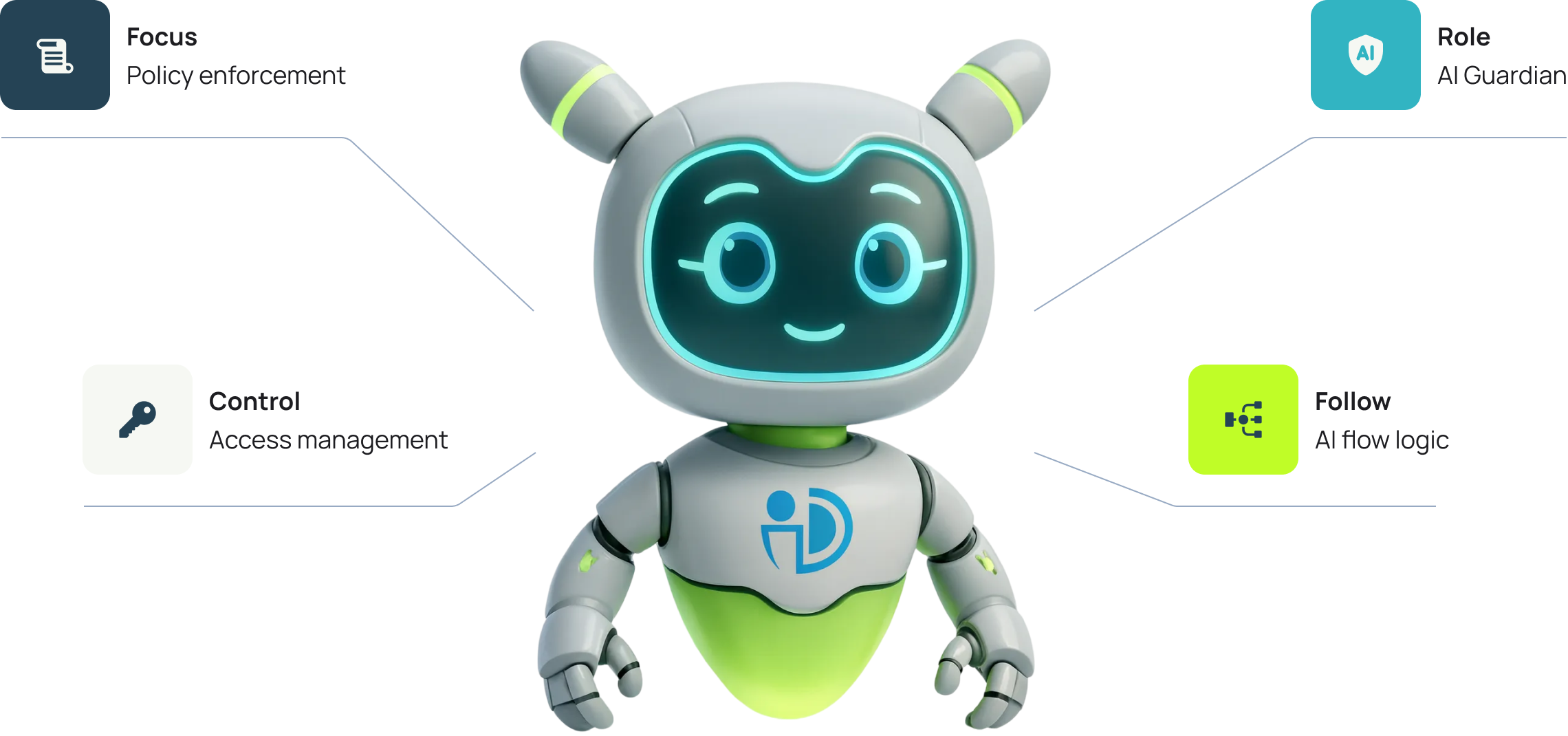
PlainID’s Runtime Authorization Platform is designed for how AI systems actually operate by accessing data, invoking tools, and making decisions across systems in real time.
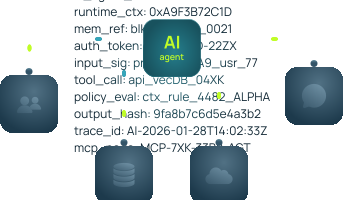
This is the critical control layer missing from traditional IAM. Every decision evaluates:
Access exists only when it’s needed, and only for the exact purpose it’s required. It’s later revoked immediately after use.
Gartner, How to Secure Custom-Built AI Agents, Dionisio Zumerle, Jeremy D’Hoinne, 11 June 2025 GARTNER is a registered trade mark and service mark of Gartner, Inc. and/ or its affiliates in the U.S. and internationally and is used herein with permission. All rights reserved.
Privilege management determines who can access your environment. Runtime authorization governs what happens inside it, at agent speed, at enterprise scale, at the moment of every action.
See how it works in your environment.

Privilege management determines who can access your environment. Runtime authorization governs what happens inside it, at agent speed, at enterprise scale, at the moment of every action.